Best Sealer for Basement Walls: Top Basement Waterproofing Solutions
Choosing the right sealer for basement walls helps prevent leaks, stop moisture migration, and protect foundation integrity. This guide reviews five highly relevant options, highlighting how each seals, cures, and performs in typical American basements. The selections emphasize durable membranes, flexible crack filling, and low-odor, eco-friendly formulations to fit DIY projects or home improvement plans.
| Product | Brand | Key Benefit | Typical Use | Approx. Coverage Mentioned |
|---|---|---|---|---|
| Ames Block & Wall Liquid Rubber Waterproofer | AMES | Flexible waterproof membrane for basements | Foundations, walls, water exposure areas | 1 gallon (as listed) |
| RadonSeal Plus Deep Penetrating Sealer | RadonSeal | Deep penetration blocks water, vapor, and radon | Basement walls and floors | 2.5 gallons |
| RadonSeal Complete DIY Foundation Crack Repair Kit | RadonSeal | Drill-free urethane injection to seal cracks | Crack repair for walls and crawl spaces | 10 ft kit |
| Applied Technologies Hydra Stop 300 Kit | Applied Technologies | Fast-set polyurethane foam for cracks | Crack repair and waterproofing | 10 ft kit |
| Flex Seal Liquid | Flex Seal | Flexible rubberized coating, versatile applications | Roof, basement, masonry, and more | 32 oz can |
Ames Block & Wall Liquid Rubber Waterproofer
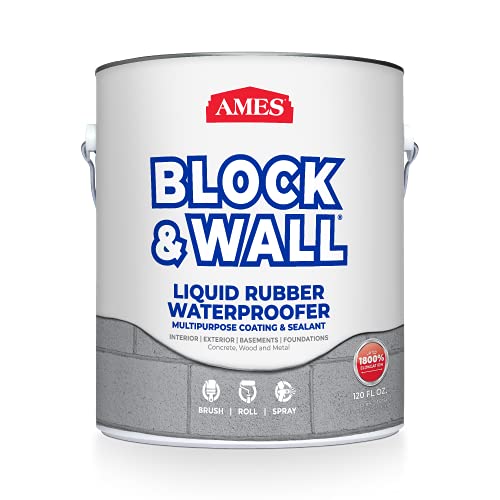
The Ames Block & Wall Liquid Rubber Waterproofer provides a flexible, white membrane designed for concrete surfaces in basements and foundations. With a focus on water resistance, this product aims to form a durable barrier against moisture ingress. It is listed with a weight of 9.25 lb and is manufactured in part with materials sourced internationally, including China. The white finish can help reflect light and reduce surface staining, while its rubberized film accommodates minor substrate movements common in basements. Suitable for DIY projects, its application benefits from standard coating techniques and adequate surface preparation.
Key features include the item weight and color for installation planning, plus general suitability for concrete sealant and waterproofing tasks in basement environments. While market expectations emphasize long-term protection, customers typically evaluate adhesion to masonry, ease of brush or roller application, and compatibility with existing waterproofing layers. This option provides a simple, single-coat approach for smaller basement walls or as part of a broader waterproofing strategy.
Liquid Rubber Basement and Foundation Repair Sealant – 5 Gallon

Liquid Rubber’s foundation sealant is marketed as a permanent waterproof membrane designed for basement waterproofing, foundation leak repair, and related applications. This 5-gallon kit emphasizes extreme elongation (up to 900%), which supports flexibility to accommodate temperature changes and minor shifts in concrete. The product is positioned as part of a complete waterproofing system intended to seal against active leaks and moisture, with compatibility noted for self-leveling concrete surfaces. It functions not only as a sealer but as a durable coating that can adapt to indoor and outdoor environments, including utility spaces, basements, and crawlspaces.
Users often assess its ability to form a continuous film, its adhesion across concrete, masonry, wood, and metal, and its performance under varying climate conditions. The emphasis on durability and a broad substrate range makes this option suitable for homeowners addressing persistent dampness, as well as DIY installers seeking a robust, long-lasting membrane.
Liquid Rubber Basement and Foundation Repair Sealant – 1 Gallon

This 1-gallon version mirrors the larger 5-gallon product’s core claims: a permanent waterproof membrane that delivers high elongation and a flexible seal for basement waterproofing, foundation repair, and crack filling. The focus remains on preventing leaks and moisture intrusion through a resilient coating that tolerates temperature shifts. The sealant’s versatile properties—strong adhesion to concrete, masonry, wood, metal, and other surfaces—make it a practical DIY choice for small-scale basement projects or spot repairs around foundation walls. The emphasis on long-term performance and compatibility with various substrates supports a wide range of basement repair scenarios.
RadonSeal Plus Deep Penetrating Concrete Sealer

RadonSeal Plus Deep Penetrating Sealer is designed to penetrate concrete up to four inches, creating a barrier against water, vapor, efflorescence, and radon gas. This deep-penetration approach aims to strengthen and preserve concrete by reducing porosity and blocking moisture pathways from within. The formula is described as water-based with zero VOCs, making it a more eco-friendly option for indoor use with minimal odor. It is particularly relevant for basement walls and floors where long-term moisture and radon mitigation are goals. Its indoor-friendly profile makes it a common choice for homeowners prioritizing safety and environmental considerations alongside performance.
RadonSeal Complete DIY Foundation Crack Repair Kit

The RadonSeal DIY Foundation Crack Repair Kit focuses on drill-free injection repair for basement walls and crawl spaces. It uses a low-viscosity urethane injected through standard caulking guns to seal cracks permanently, helping to prevent ongoing water seepage. The kit emphasizes ease of use for homeowners, enabling a straightforward application without heavy drilling. By curing into a durable barrier, the urethane provides a long-term solution for hairline cracks that contribute to basement moisture problems and potential structural concerns. This kit is suitable for DIY enthusiasts seeking a targeted, crack-specific approach rather than a broad surface coating.
Applied Technologies Hydra Stop 300 Crack Repair Kit

The Applied Technologies Hydra Stop 300 kit provides a complete crack repair solution using polyurethane foam that expands to fill cracks in concrete foundations. This quick-setting option is designed for DIY use, offering a practical method to create a durable, waterproof seal that helps prevent basement flooding and water damage. The emphasis is on a fast-setting, expandable foam that expands to seal gaps effectively, contributing to a proactive approach to basement waterproofing by addressing cracks at their source. The kit is marketed as a straightforward, user-friendly option for homeowners handling basement foundation repairs without professional contracting services.
Flex Seal Liquid – Rubber Coating

Flex Seal Liquid is a versatile liquid rubber coating that can be brushed, rolled, dipped, or poured onto various surfaces. Marketed as a watertight, flexible coating, it provides a quick and easy option for sealing leaks and moisture across basements, roofs, masonry, and other areas. The product’s flexibility and UV resistance make it suitable for outdoor transitions too, while its user-friendly application appeals to DIY projects. The coating forms a protective layer that resists water, air, and moisture, with rapid coverage and adaptable use across multiple substrates, including basement walls and connected spaces.
Buying Guide: Key Purchase Considerations for Basement Wall Sealers
- Sealing vs. penetrating action: Choose a surface sealant for broad waterproofing or a penetrating sealer for long-term moisture mitigation. Deep-penetrating products may better reduce radon and vapor transmission, while surface coatings provide immediate barrier formation.
- Flexibility and crack management: Basements experience temperature changes and settling. Look for sealants with high elongation or flexible polymers to accommodate minor shifts without cracking.
- Substrate compatibility: Concrete, masonry, and wood all respond differently to coatings. Ensure the product adsorbs well to concrete and masonry, and verify compatibility with any existing coatings or paints.
- UV exposure and indoor use: If a basement walls are uninsulated or exposed to sunlight in certain areas, UV-stable formulas and low-VOC options may be desirable for safety and indoor air quality.
- Application method and cure time: DIY projects benefit from easy-to-apply products and clear cure times. Quick-set formulas can reduce downtime, while longer cures may deliver deeper penetration for some applications.
- Coverage and project scope: Evaluate project size to determine the amount of product needed. Interior walls often require multiple coats or larger volumes for full coverage, especially in damp basements.
- VOC and odor considerations: Low-VOC and odor-free formulas are preferable for living spaces and basements with limited ventilation.
- Repair approach: For active leaks, layered strategies using crack fillers followed by a protective membrane often yield the best results. In some cases, radon mitigation or additional drainage improvements may be part of a comprehensive plan.
- DIY vs. professional installation: While many products are marketed for DIY use, persistent leaks, large cracks, or structural concerns may warrant professional assessment and specialized equipment.
- Safety and environmental considerations: Prioritize products with safer solvent profiles and environmentally friendly formulations when working in enclosed spaces.