Best Self Etching Primer for Plastic: Top Picks and Buying Guide
Self etching primers are essential for preparing bare or difficult surfaces when painting plastics used in automotive, marine, and hobby projects. The right product bonds well, resists rust, and provides a solid base for topcoats. This article spotlights five top options that perform well on plastic and challenging substrates, helping you choose based on adhesion, drying time, and ease of use. Below, you’ll find a concise product summary and in-depth sections for each primer, followed by a practical buying guide.
| Product | Brand | Type | Key Benefit |
|---|---|---|---|
| JENOLITE Universal Etch Primer | JENOLITE | Self Etching Primer | Topcoat ready on difficult surfaces |
| Custom Shop Premium Gray Self Etching Primer | Custom Shop | Self Etching Primer | Excellent adhesion to bare metals and plastics |
| Seymour 20-1675 PBE Professional Primer | Seymour | Self Etching/Weld Through Gray | Durable zinc-enhanced coating |
| SEM 39673 Black Self Etching Primer | SEM | Self Etching Primer | Excellent adhesion; quick drying |
| SEM 39683 Grey Self Etching Primer | SEM | Self Etching Primer | General purpose gray etch primer |
The following sections provide detailed insights into each product, focusing on how they perform on plastic and other challenging surfaces, along with practical usage tips and considerations for choosing the right primer for your project.
JENOLITE Universal Etch Primer

JENOLITE’s Universal Etch Primer is designed for difficult-to-paint surfaces, including aluminum, galvanized steel, stainless steel, GRP, and plastic. It provides a self-etching layer that primes bare substrates and creates a uniform base for topcoats. The product advertises being topcoat ready, helping streamline workflows for automotive or industrial applications. Typical use cases involve corrosion prevention on exposed metal components where plastic integration or composite materials are present. Application consistency and dry-to-handle times support efficient paint schedules on workshop floors.
Key features include self-etching action that improves adhesion to challenging substrates, topcoat readiness, and suitability for metals commonly found in automotive bodies as well as certain plastics. When using on plastic, ensure the surface is clean, dry, and free of wax or release agents. Lightly scuffing plastic can help adhesion further, and a compatible topcoat should be chosen to maximize the finish. Always follow the manufacturer’s data sheet for film thickness and cure times to avoid immobilizing the project.
Custom Shop Premium Gray Self Etching Primer

Custom Shop Premium Gray Self Etching Primer is presented as a ready-to-spray acid-etch primer that provides tremendous adhesion to a variety of substrates, including bare metal, aluminum, fiberglass, and some plastics. The gray primer color helps achieve a uniform base before applying color coats. It’s described as versatile for fleet and OEM manufacturing contexts, offering anti-corrosive properties that boost long-term durability. The formulation is designed to etch and prime in one step, reducing prep time while maintaining high adhesion and flexibility for painted surfaces.
For plastic applications, this primer can create a stable base for subsequent topcoats, particularly on parts where bare metal exposure or prior paint removal occurred. Surface preparation remains critical: clean surfaces, remove oils, and scuff plastics as needed to optimize bonding. Use the recommended spray technique to avoid runs, especially on larger plastic panels where surface tension can affect film uniformity. If possible, test adhesion on a small area before full application.
Seymour 20-1675 PBE Professional Primer

Seymour’s 20-1675 PBE is described as a self-etching/weld-through gray primer with a durable zinc-enhanced coating. It emphasizes electrochemical galvanic protection, maintaining corrosion resistance even if the surface is scratched during handling or welding. The dry film is engineered to reduce smoke and electrode wear when welding, which can be beneficial for metal parts adjacent to plastic components where a compatible primer is needed before painting. While the emphasis is on metal substrates, the formulation’s bonding and protection properties can support plastics tied into metal assemblies.
When using this product on plastic, ensure proper surface preparation to prevent delamination. This primer can help establish a robust base for subsequent primers or topcoats, especially in mixed-material assemblies common in automotive or industrial applications. Follow recommended cure times and film thickness guidelines to prevent pinholes or uneven coverage on irregular plastic shapes. A test patch is advisable on plastics with previously applied coatings or treatments.
SEM Black Self Etching Primer

SEM’s 39673 Black Self Etching Primer is noted for excellent adhesion to steel, aluminum, and stainless steel with quick-drying properties. While its core strength lies in providing a reliable base for metal substrates, its compatibility with plastics is often considered when plastics are part of a larger assembly or when adjacent metal components require a matched base color for later finishing. The product’s rapid drying can help streamline production lines, reducing downtime between primer and topcoat steps.
For plastic surfaces, proper surface preparation is essential. Use a compatible adhesion-promoting primer on plastics before applying the self-etching layer if the surface is highly resistant or untreated. If choosing this primer for mixed-material parts, consider testing adhesion and film integrity across multiple substrates to ensure a uniform finish. Maintain optimal spray technique and environmental conditions to avoid solvent entrapment or surface tension issues on shaped plastic parts.
SEM Grey Self Etching Primer
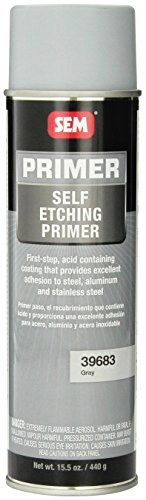
SEM’s 39683 Grey Self Etching Primer provides a general-purpose gray base ideal for a variety of substrates, including plastics in some contexts. It is positioned for compatibility with standard color matching and topcoat processes. The package dimensions suggest a generous can size, supporting larger projects or fleets. Practically, this primer can serve as a versatile base layer when plastic components are part of assemblies with metal or composite materials.
When applying to plastic, attention to surface cleanliness and conditioning remains essential. Scuffing and degreasing prior to application will aid in achieving a consistent film. The gray tone helps with color matching during finish coats, reducing the need for multiple base layers. For best results, adhere to recommended recoat windows and cure times to prevent wrinkling or poor adhesion on tricky surfaces.
Buying Guide: Self Etching Primers For Plastic
- Surface compatibility: Look for primers explicitly listing plastics and challenging metals (aluminum, galvanized steel, stainless) to ensure adhesion on mixed surfaces.
- Etching strength vs. topcoat readiness: Some products offer one-step etching and priming, while others require a separate topcoat or sealant. Assess project timelines and health/safety considerations.
- Drying and recoat windows: Faster dry times boost productivity, but ensure the coating cures adequately to prevent cracking or poor adhesion after topcoat application.
- Film thickness and coverage: Check recommended coverage per can and optimal wet/dry film thickness to avoid runs and pinholes on contoured plastic parts.
- Adhesion performance: For plastics, adhesion can vary by substrate finish (smooth vs. textured) and by prior treatments. Perform a test patch where possible.
- Durability and corrosion protection: Zinc-enhanced or corrosion-inhibiting formulations can add long-term protection for metal-plastic assemblies exposed to harsh environments.
Overall, the selected products provide a range of options from high-adhesion, topcoat-ready primers to versatile gray and black formulations. When choosing, consider the substrate composition, the presence of bare metal in the assembly, and the topcoat system planned for use. For plastic-heavy projects, prioritize products explicitly marketed as suitable for difficult surfaces or plastics, and plan for a patch test prior to full-scale application.