Best Self Leveling Compound for Concrete: Top Picks for Repair and Renovation
Choosing the right self-leveling product can simplify concrete repairs, from filling cracks to sealing expansion joints. This guide highlights five highly relevant options that American homeowners and contractors trust for quick, durable results. Each entry covers core features, application notes, and suitability for common concrete surfaces like driveways, floors, and sidewalks.
| Product | Brand | Type | Main Use |
|---|---|---|---|
| SIKA Sikaflex Self-Leveling Sealant, Gray, 10.1 fl oz | SIKA | Self-Leveling Sealant | Expansion joints, waterproofing, crack filling |
| SIKA Sikaflex Self Leveling Sealant, Gray, 29 fl oz | SIKA | Self-Leveling Sealant | Horizontal expansion joints, large areas |
| ABATRON Abocrete Kit | Abatron | Self-Leveling Epoxy Patch | Structural patching and rebuilding |
| Concrete Crack Filler 4 Pack, Heelos | Heelos | Self-Leveling Crack Filler | Crack repair, waterproofing |
| 3M Concrete Repair Self-Leveling, Gray, 8.4 fl oz | 3M | Self-Leveling Repair | Cracks and spalls on horizontal surfaces |
Note: All products listed are suitable for concrete surfaces common in American homes and small commercial spaces. For best results, follow the manufacturer’s prep and cure times as directed on each product page.
SIKA Sikaflex Self-Leveling Sealant, Gray — 10.1 Fl Oz

Designed for expansion joints and horizontal surfaces, this polyurethane-based sealant provides self-leveling flow and permanent elasticity, improving joint integrity over time. The product cures to a tack-free state within a few hours and reaches full cure in less than a week, allowing painting, sanding, or staining after initial set. It’s waterproof and immersion-ready after curing, helping prevent water infiltration in driveways, garages, and sidewalks. Ideal for smaller to mid-sized joints where a fast, durable seal is required.
Key features include quick curing, water resistance, and paintability, which make it a versatile choice for both interior and exterior concrete projects. This variant emphasizes easy application across uneven surfaces without creating bumps or ridges, helping achieve a smooth finish along expansion joints and cracks up to the product’s tolerance. Suitable for typical residential repair tasks where surface movement is expected and moisture exposure is a concern.
SIKA Sikaflex Self Leveling Sealant, Gray — 29 Fl Oz

This larger-volume cartridge is tailored for bigger projects or frequent use, delivering the same self-leveling behavior and elasticity as the smaller variant but at greater coverage. It remains waterproof after curing and offers a seamless finish across concrete surfaces. The formulation supports horizontal expansion joints and can be painted or stained once fully cured, which is helpful for matching color in exposed concrete areas such as patios and walkways. Its extended cure window provides flexibility when tackling expansive repair zones.
Consider this option when planning repairs that cover wider expansion joints or when you want to minimize reapplication frequency on larger concrete floors. The product’s performance in high-traffic areas is supported by its durability and resistance to water intrusion, making it a practical choice for long-term maintenance programs on residential properties.
ABATRON Abocrete Kit — Self-Leveling Epoxy Patch

The Abocrete Kit combines self-leveling epoxy patching with strong bonding properties suitable for structural repairs. It bonds, levels, and resurfaces concrete floors, steps, and other rigid surfaces, making it a robust choice for serious repairs—especially where surface irregularities or spalling are present. This kit is designed for permanent repairs, enabling you to rebuild concrete surfaces with improved strength and stability. It is also GREENGUARD certified, indicating low VOCs and reduced odor for safer indoor use.
Applications include filling voids, rebuilding worn sections, and restoring structural integrity after damage from salt exposure or heavy traffic. While not a traditional cement-based leveling compound, its epoxy-based self-leveling capability offers excellent durability for concrete repair projects where mechanical strength is a priority. Users should follow mixing instructions precisely to achieve optimal cure and bonding results.
Concrete Crack Filler, Heelos — 4 Pack
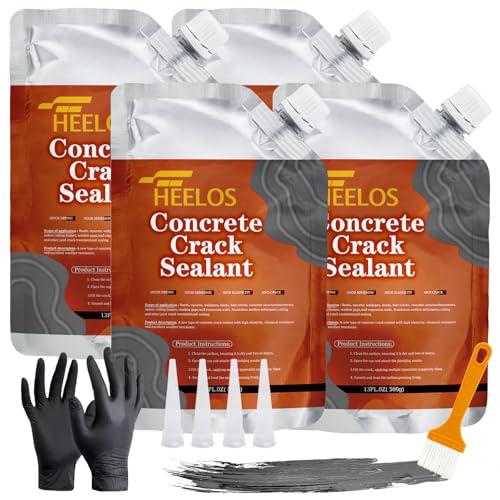
This set includes four packs of ready-to-use concrete crack filler with high elasticity to handle ground shifts and temperature changes. It creates a waterproof barrier that resists UV exposure and weather extremes, helping to prevent re-cracking and degradation in outdoor spaces such as driveways and patios. The product cures relatively quickly, delivering a smooth, flat finish ideal for pedestrian and light vehicle areas. Its emphasis on flexibility and weather resistance makes it a reliable option for crack sealing in varying climates across the United States.
With a combined total of over four liters of material, Heelos provides a practical solution for multiple cracks across a single project. The emphasis on waterproofing and crack resistance helps ensure longer-term durability, especially in environments with freeze-thaw cycles. It’s suitable for DIY repairs as well as small contractor jobs where consistent performance across several patches is beneficial.
3M Concrete Repair Self-Leveling — 8.4 Fl Oz

3M’s self-leveling repair product is designed for quick correction of cracks and spalls on horizontal concrete surfaces. Its urethane-based formula flows into repair areas and levels itself to a smooth surface, delivering a tack-free finish rapidly—sometimes within a minute. This fast response is useful for urgent patch jobs in garages, basements, or walkways where downtime is a factor. The product’s flow characteristics ensure even distribution across uneven repair zones, supporting a durable, level result after curing.
As with other self-leveling products, proper surface preparation—cleaning, drying, and removing loose material—helps maximize adhesion and long-term performance. This option is well-suited for homeowners seeking quick fixes without heavy equipment or extensive downtime. Its rapid set can reduce project timelines while still delivering a professional-grade repair.
Buying Guide: Key Considerations For Self-Leveling Concrete Compounds
When selecting a self-leveling compound for concrete, consider the following factors to ensure the best result for your space and climate.
- Surface type and joint size — Choose products engineered for horizontal expansion joints or crack repair. For larger joints, a higher volume cartridge or epoxy-based patch may be preferable.
- Cure time and traffic exposure — Quick-curing formulas minimize downtime but may require faster work sessions. For high-traffic areas, look for durable, waterproof formulations with robust adhesion.
- Substrate preparation — Most products demand clean, dry, and neutral pH surfaces. Follow manufacturer guidelines for priming and moisture testing to maximize bond strength.
- Flexibility vs. rigidity — Sealants (polyurethanes) offer elasticity that accommodates movement, while epoxy patches deliver high compressive strength for structural repairs.
- VOC content and safety — Greenguard or low-VOC certifications are desirable, especially for indoor applications or spaces with limited ventilation.
- Color and finish — Some products cure gray, sandstone, or other hues and can be painted or stained after curing. Ensure color compatibility with surrounding concrete if aesthetics matter.
- Application tools and experience — Self-leveling sealants and epoxy patches have different mixing, curing, and tooling requirements. Ensure the product aligns with your skill level and available tools.
Performance expectations vary by climate. In freeze-thaw regions, opt for formulations with proven water resistance and elasticity to minimize crack propagation. For indoor spaces, low odor and fast cure times reduce disruption during repairs. Finally, evaluate the long-term maintenance plan: sealants protect expansion joints but may require reapplication every few years, while epoxy patches offer lasting structural repair when properly installed.