Best Small Solar Panel Kit for RVs and Off-Grid Power
Discover compact solar panel kits designed to deliver dependable off-grid power without taking up too much space. This guide highlights five small-to-midsize kits that balance portability, efficiency, and ease of use for RVs, cabins, boats, and tiny off-grid setups. Each option includes a reliable charge controller, durable hardware, and practical performance in varying sunlight. Compare features, installation requirements, and compatibility to choose the best kit for your needs.
| Product | Brand | Daily Output | Best For |
|---|---|---|---|
| ECO-WORTHY 200W 12V Complete Solar Panel Starter Kit | ECO-WORTHY | 800Wh (4 hours sun) | RV, cabin, trailer power needs |
| Renogy 200W 12V RV Solar Kit | Renogy | 800Wh (4 hours sun) | RVs, campers |
| SOLPERK 20W Solar Panel Kit | SOLPERK | Varies with sun; 20W panel | Small projects, trickle charging |
| AOSHIKE 10Pcs Mini Solar Panels Kit | AOSHIKE | 5V 30mA per mini panel | DIY toys and models |
| ECO-WORTHY 400W 12V Premium Kit | ECO-WORTHY | Up to ~1.6kWh/day (varies) | Compact off-grid homes and boats |
Note: All kits include a combination of solar panels, charge controllers, and mounting hardware. Real-world output depends on sun conditions, temperature, and system configuration.
ECO-WORTHY 200 Watts Starter Kit

The ECO-WORTHY 200W kit focuses on practical, everyday off-grid power. It uses high-efficiency monocrystalline panels and includes a 30A PWM charge controller, suitable for RVs, campers, and other mobile setups. The system is designed for enduring outdoor use with a corrosion-resistant aluminum frame and IP65-rated junction box. Expect up to 800Wh daily under favorable sun conditions and adaptivity for varying weather. The durable design supports wind and snow loads, helping it endure long-term outdoor exposure.
ECO-WORTHY 200W Starter Kit With Battery
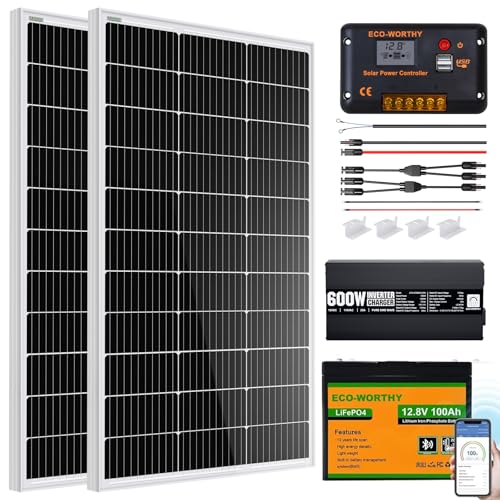
This complete solar kit pairs 200W of panels with a 12.8V 100Ah lithium battery, plus a 1000W class inverter and a 30A controller. It targets RVs, cabins, and mobile homes needing a robust energy storage and AC power capability. The included lithium battery offers high cycle life and built-in BMS protections for overcharge, overdischarge, and short circuits. Expect an 800Wh daily output under optimal sun and reliable performance in mixed environments. The kit emphasizes longevity with corrosion-resistant framing and strong weather resistance.
Renogy 200W 12V RV Solar Kit
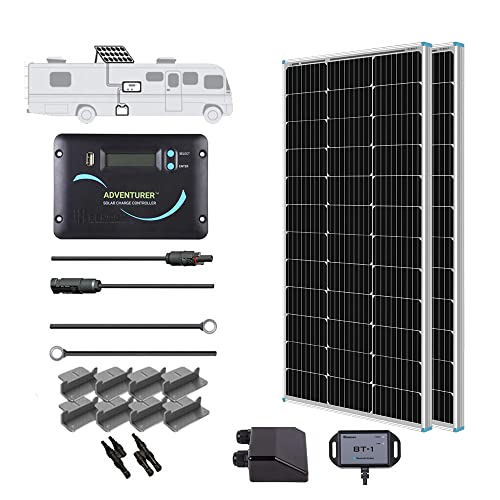
Renogy’s 200W kit is designed for compact footprints with a 22% efficiency rating. It features corrosion-resistant aluminum framing and a PWM Adventurer controller for safe, straightforward operation on RVs, campers, boats, and small off-grid builds. The included mounting hardware and pre-drilled panels enable easier installation. The controller provides basic protections and maintains a stable charge to your battery bank. This kit is favored for those seeking a balanced, ready-to-install system with reliable Renogy components.
Renogy 400W Premium Kit

The 400W Renogy Premium Kit provides more power in a compact form, using four 100W panels and a 40A MPPT controller. It supports higher daily energy capture and is suitable for larger RV setups, cabins, or small off-grid homes. The kit includes mounting hardware and cables, and Renogy’s MPPT controller delivers higher efficiency and smarter charging, especially under partial shading or cooler temperatures. While larger than ultra-portable options, it remains a strong choice for scalable off-grid power with robust warranty coverage.
Buying Guide: Key Purchase Considerations
- Power needs and daily usage: Estimate your typical daily energy consumption and match it to the kit’s wattage, voltage, and expected daily output under your sun conditions.
- System type and compatibility: Decide between PWM and MPPT controllers, and confirm compatibility with your battery bank (lead-acid vs. lithium) and inverter if you need AC power.
- Portability and space: For limited spaces (RV roofs, cabins, boats), prioritize compact panels and lighter mounting solutions without sacrificing efficiency.
- Durability and weather resistance: Look for corrosion-resistant frames, IP ratings for junction boxes, and validated wind/snow load tolerances to ensure longevity in outdoor use.
- Warranty and support: Consider warranty length, coverage on panels and controllers, and the availability of replacement parts or accessories.
- Ease of installation: Check included mounting brackets, pre-wired cables, and whether fine-tuning (like MPPT tuning) is straightforward for DIY setups.
- Battery compatibility and size: Ensure the kit’s controller and wiring are suitable for your battery chemistry (lithium vs. lead-acid) and the battery’s capacity and charging profile.
- Expandable options: If you anticipate future power needs rising, choose kits with modular components or clearly compatible add-ons.
Different perspectives emphasize portability, daily energy yield, and system complexity. A compact 20W or 200W kit is ideal for light charging or supplemental power, especially where space is at a premium. For greater resilience and higher daily output, a 400W-class kit with an MPPT controller offers more headroom, though installation and weight increase. Lithium battery integration can dramatically improve cycle life and performance, but may require careful battery management.