Best Stair Lift Options for Curved Stairs in the Home
Finding a stair lift tailored for curved stairs requires evaluating track design, weight capacity, installation needs, and practicality for everyday use. The following selections highlight curved-stair-friendly solutions and related assistive devices to help you compare performance, safety, and value. Each entry includes key features to aid an informed purchase decision.
Summary of Selected Products
| Product | Brand | Weight Capacity | Install Type | Key Benefit |
|---|---|---|---|---|
| AmeriGlide Rave 2 Stair Lift | AmeriGlide | 350 lb | Self Installable | Self-install option with compact footprint |
| RXFSP 880lb Electric Stair Climbing Hand Truck | RXFSP | 880 lb | Mobile Dolly | Handles curved stairs with power-assisted ascent |
| RXFSP 880LB Electric Stair Climbing Hand Truck (Alternate) | RXFSP | 880 lb | Mobile Dolly | Three speed options for heavy loads |
| Stair Climbing Wheelchair (BELIVOR) | BELIVOR | 480 lb | Stair-Climbing Wheelchair | Rugged, portable mobility with stair capability |
| PDTHADP 2-in-1 Function Stair Climbing Assist Cane | PDTHADP | ~330 lb | Assist Cane | 2-in-1 design for stairs and standing support |
AmeriGlide Rave 2 Stair Lift
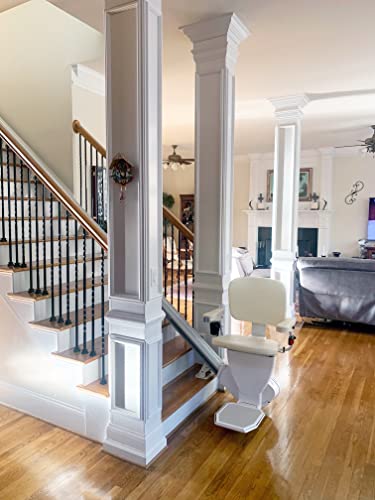
AmeriGlide’s Rave 2 is a curved-stair friendly stair lift designed for home installations with a self-install option. It emphasizes flexibility for tight turns, a compact footprint, and a 350 lb weight capacity. The model includes 15 ft of track and built-in battery power, enabling operation during power outages. Its self-install capability offers a cost-conscious path for homeowners comfortable with DIY projects.
RXFSP 880lb Electric Stair Climbing Hand Truck

This RXFSP model is designed for heavy-duty use on stairs, including curved configurations. It features a solid steel frame, a foldable toe plate, and non-slip tires for improved safety. With a 1200W brushless motor and a load capacity of 880 lbs, this device supports robust vertical movement on complex stair layouts and provides multiple speed settings to match task demands. It is well-suited for caregivers and professionals moving heavy loads up and down stairs.
RXFSP 880LB Capacity Electric Stair Climbing Hand Truck – Alternate

This variant duplicates the heavy-duty capabilities with a focus on straight and curved stairs. It provides high torque, a 1200W brushless motor, and 6-8 hours of battery life, enabling efficient movement of heavy items across stair configurations. Variable speeds cater to careful navigation on curved routes, making it a practical choice for frequent stair work in multi-level homes or small businesses.
Stair Climbing Assist Cane (HeywoodCabin)

The HeywoodCabin stair climbing assist cane offers a lighter option for navigating stairs with a 300 lb capacity. While not a traditional stair lift, it provides dual stability through an ergonomic handle and four non-slip feet. It is designed to reduce wobble and promote safer ascent and descent on straight stairs, making it a potential supplementary aid in curved stair settings where a full lift is not required.
PDTHADP 2-in-1 Stair Climbing Assist Cane

The PDTHADP 2-in-1 design blends a stair-assisted reach with a cane’s mobility. With 10 adjustable heights and a maximum load around 330 lbs, it supports users who need assistance for ascending and descending stairs without committing to a full lift. The product’s compact form factor and height adjustability make it versatile for varied stair cases, including curved layouts where space is a consideration.
Buying Guide: Choosing The Right Solution For Curved Stairs
When selecting a stair assist for curved stairs, consider these factors to balance safety, usability, and value:
- Track design and fit: Curved stairs require dedicated curved tracks or compatible modular components. Ensure the model accommodates the stair’s radius and turns without overly extending into the corridor space.
- Weight capacity and loads: Evaluate the combined weight of the user, potential passengers, and folded mobility aids. Higher capacity models like 880 lb handles heavier needs but may come with larger footprints and installation considerations.
- Power source and reliability: Battery-powered systems can operate during outages, but check run-time and charging options. For high-traffic homes, a dependable system with backup power is beneficial.
- Installation requirements: Self-install options can reduce costs but require accurate measurements and tools. Professional installation can ensure safety and warranty adherence for curved configurations.
- Portability vs. permanence: Standalone stair climbers and portable wheelchairs offer flexibility but may be less suited for long-term home integration. Fixed lifts provide continuity but involve more installation.
- Safety features: Look for anti-slip surfaces, secure seat belts, stable handrails, emergency stop controls, and battery backup to minimize risk on curved stairs.
- Maintenance and support: Check warranty length, service availability, and replacement parts for curved-track systems, as specialized components may require authorized service.
Choosing the optimal curved-stair solution involves aligning user needs with the environment: a compact, easy-to-install lift may suit single-story homes with tight turns, while a high-capacity, motorized hand truck could support caregivers moving heavy items along curved routes. For caregivers and family members, a combination of a traditional lift for frequent use and a secondary assistive device for occasional tasks can offer a balanced approach. Always verify measurements, track compatibility, and warranty terms before purchase.