Best Stair Lifts for Homes: Safe, Reliable Options for Everyday Access
Choosing the right stair solution for a home requires weighing weight capacity, installation needs, and daily usability. This guide highlights five top options designed for domestic use, from self-installable lifts to portable stair-climbing devices. Each product is evaluated for safety, ease of use, and suitability for straight staircases, helping readers compare practical choices for improving home accessibility.
| Product | Brand | Key Strength | Track/Weight Note |
|---|---|---|---|
| AmeriGlide Rave 2 Stair Lift | AmeriGlide | Self-installable; 350 lb capacity | 15 ft track |
| Powered Wheelchair Stair Climbing Chair (Model XFGW30-107) | FADHOLE | High load; caregiver-controlled | Load up to 480 lb |
| Stair Climbing Dolly 880 lb | DZXW | Heavy-duty moving on stairs | 880 lb capacity |
| Stair Climbing Assist Cane | HeywoodCabin | Portable assist with stability | Supports up to 300 lb |
| Power Climbing Wheelchair | BELIVOR | Next-gen stair navigation | 480 lb capacity |
The following sections present five key products in detail. Each entry explains how the device works at home, who benefits most, and practical considerations for installation and daily use.
AmeriGlide Rave 2 Stair Lift
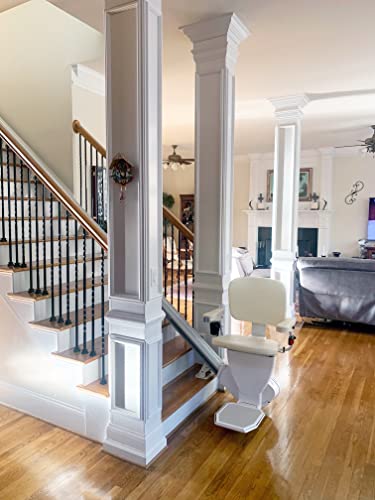
The AmeriGlide Rave 2 Stair Lift is designed for homes seeking a straightforward, self-installable solution. It offers a 350 lb weight capacity and comes with 15 feet of track, enabling installation on many straight stair configurations without heavy remodeling. Battery-powered operation provides continued use during power outages, enhancing reliability in daily home routines. The unit’s compact rail design minimizes bulk on narrow staircases, supporting both mobility-impaired users and caregivers who need a predictable, low-effort ascent or descent.
Key considerations for this model include ensuring a proper wall-to-stair fit for the track, confirming compatible door and corridor clearances, and planning for a possible one-person operation workflow. As a self-install option, tuning the seat belt, rail alignment, and battery health are important maintenance steps to sustain smooth operation over time.
Powered Wheelchair Stair Climbing Chair (Model XFGW30-107)

The FADHOLE stair climbing chair focuses on independent mobility at home, offering a powered lift that is especially helpful for caregivers managing stair transitions. Built with a sturdy aluminum alloy frame and a 480 lb load capacity, it balances durability with a lighter footprint than some full-size lifts. The control panel is designed for caregiver operation, enabling controlled, slow ascent and descent on straight stairs. Not suited for spiral staircases, this model remains a practical option for multi-level homes with linear stair layouts.
Considerations include ensuring the chair’s width and seat dimensions match user needs, evaluating the ease of delivering the chair onto and off the landing, and confirming favorable clearance around doorways and landings. Regular maintenance of the control panel and track alignment will support consistent performance.
Electric Stair Climbing Dolly

The Electric Stair Climbing Dolly from DZXW is designed for heavy-duty moving tasks on stairs, supporting up to 880 lbs with a robust 1200-watt motor. This device is ideal for households or small businesses that frequently move large items like appliances or furniture between floors. Its foldable design facilitates storage when not in use, and the intuitive control system allows one person to operate the cart on stairs and uneven surfaces. This is a practical complement to stair lifts when daily mobility needs involve occasional heavy-lifting tasks on stairs.
Key considerations include choosing the right handhold height and ensuring the stair dimensions meet the cart’s wheelbase and clearance requirements. Users should verify flooring transitions, lockout mechanisms, and safety features such as braking controls before regular use.
Stair Climbing Assist Cane

The HeywoodCabin Stair Climbing Assist Cane provides a portable option for users needing support on stairs without a fixed lift. It supports up to 300 lbs and uses an anti-slip handle along with four stabilizing rubber feet to resist wobble on various stair surfaces. This device is well-suited for users who require a lightweight, grab-and-go solution or for homes where a permanent stair lift isn’t feasible. It’s particularly helpful for mid-stair pauses, transfers, or as an extra safety aid for caregivers during stair negotiations.
When considering this cane, evaluate grip comfort, the stair material compatibility, and the cane’s adaptability to different step heights. The lighter weight and foldability can be advantageous for travel or temporary use across rooms with stairs.
Power Climbing Wheelchair

The Belivor Power Climbing Wheelchair is designed as a next-gen option for stair navigation, combining a 480 lb load capacity with a compact, portable frame. This model emphasizes a balance between indoor maneuverability and outdoor resilience, using a rugged aluminum alloy construction and reinforced seating. It aims to offer smooth, safe operation on standard straight staircases, making it a practical alternative to bulkier stair lifts for some home layouts. Careful attention to chair width, control responsiveness, and battery life will help ensure dependable daily performance.
Important considerations include testing for tight stair landings, ensuring user comfort in the seating and armrest dimensions, and planning for routine battery checks and motor maintenance to maintain performance over time.
Buying Guide: Key Purchase Considerations For Home Stair Solutions
- Home layout and staircase type: Confirm whether the stairs are straight or curved, the width, and the landing space. Some devices are restricted to straight stairs and may not fit curved layouts.
- Weight capacity and user needs: Match the device’s weight limit to the user’s body weight and any assistive equipment. High-capacity models provide flexibility for future changes in mobility.
- Installation and maintenance: Self-installable lifts may reduce upfront costs but require careful assembly and periodic maintenance checks. Professional installation may be advised for complex stairs.
- Power reliability: Battery-powered options offer resilience during outages. Consider charging routines and accessibility to power outlets at the stair landing.
- Safety features: Look for secure seating, reliable braking systems, smooth operation speeds, and clear control interfaces. Anti-slip handles and stable bases are essential for risk reduction.
- Portability vs. permanence: Portable stair climbers and assistive canes offer flexibility but may trade off some stability compared with fixed lifts. Choose based on long-term mobility expectations and household use.
- Maintenance and warranties: Review included warranties, replacement part availability, and typical service intervals to ensure ongoing performance.
- Cost and return policy: While prices aren’t listed here, evaluate total cost of ownership, including installation, parts, and potential professional service.
- User training: Some devices require caregiver involvement for safe operation. Ensure caregivers receive proper instruction on safety protocols and device controls.