Best T Spacers for Tile Installations: Quick, Precise Joints for Any Room
Answering the common question for DIYers and pros: these tile spacers keep joints even and grout lines straight, while many models offer features that save time or improve installation accuracy. The best picks here are ideal for 1/8 inch and 1/16 inch grout joints, with options that suit wall or floor tiling, offset patterns, and edge-to-edge layouts. This guide highlights spacers that minimize rework, support different tile types, and fit varying project scopes. The buyer can select a spacer type based on joint size, ease of removal, and whether the spacer is reusable or left in place after grouting.
Summary table of selected products
| Product | Best For | Key Benefit |
|---|---|---|
| Leave-in design with voids; saves time by not removing spacers | ||
| Versatile T/straight options for precise alignment | ||
| Flexible layout options with + and T styles | ||
| Large count; T-shaped spacers for rectangular brick layouts | ||
| Durable PE plastic; comprehensive pack for bigger projects |
BARWALT Precision Leave-in-Tile Spacers, 1/8 Inch

Best for: projects with long runs and a 1/8 inch grout joint. This product uses a leave-in design that features voids, allowing grout to be applied over the spacer. The key advantage is time savings: installers do not need to remove spacers before grouting, reducing labor and cleanup. Suitable for ceramic, porcelain, and stone tiles that require consistent 1/8″ gaps. A potential limitation is that leave-in spacers may not be ideal for all tiling patterns where grout alignment is critical after initial curing.
BARWALT Dual Sided T Shaped Tile Spacers, 100 Pack

Best for: offset intersections and edge-to-edge layouts where even spacing is crucial. The dual-sided design supports both T and straight edge usage, helping maintain consistent grout lines across complex patterns. Ideal for universal tile types and quick removal after adhesive sets. The main caveat is that, depending on the workflow, you may still remove spacers in some situations to ensure a pristine seam around corners or at transitions.
BARWALT Precision Tile Spacers, 1/16 Inch

Best for: achieving precise 1/16 inch grout joints on walls or floors. These spacers are described as universal for tile types and come in both + and T styles for layout versatility. They help create a uniform finish, which is particularly important for porcelain and natural stone installations where grout lines must read cleanly. A potential limitation is that ultra-fine gaps can be more sensitive to adhesive movement during curing, so consistent troweling is essential.
Tavy T-spacers 1/8″
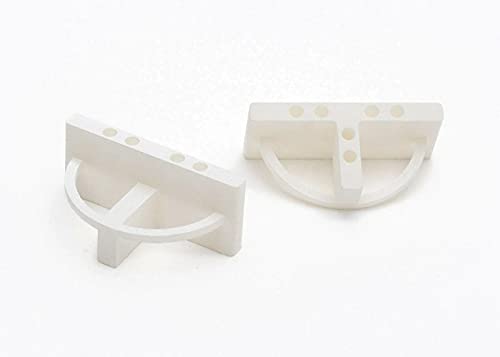
Best for: offset tile installations where a straight grout joint is desired. T-spacers offer two usable sides—T and Straight Edge—facilitating the straightest possible grout lines in offset patterns. A limitation is that their performance relies on accurate placement; misalignment at the start can propagate errors across the run, so careful alignment is essential.
Cosmos 600 Pcs 1/8″ Tile Spacers

Best for: quick installations with 1/8 inch joints, especially in wall or floor tiling where consistency across many tiles is key. The T-shape helps with rectangular grid layouts. A limitation to watch is the need to verify spacer size before purchase to ensure compatibility with the chosen tile thickness and grout profile.
uxcell 300Pcs Wall Floor Tile Spacers, 10mm

Best for: larger tile gaps and projects requiring robust spacers in 10mm (approximately 3/8″) joints. The spacers come in a large 300-piece pack, made of durable PE plastic with smooth edges to minimize tile shifting during installation. A note: the 10mm size is significantly wider than standard 1/8″ or 1/16″ joints, so use in projects designed for larger grout lines and verify tile layout compatibility.
Buying Guide: Key Considerations For Your Tile Project
- Joint size compatibility: Match spacers to your grout joint target (common sizes include 1/8″ and 1/16″).
- Leave-in vs. removable: Leave-in spacers save time but may not suit every pattern; removable spacers allow post-install adjustments.
- Spread and pattern: T-spacers and dual-sided spacers work well with offset or brick patterns; straight-edge spacers suit grid layouts.
- Tile type compatibility: Ensure spacers work with ceramic, porcelain, marble, or stone tiles being installed.
- Count and project scale: Large projects benefit from bulk packs to minimize interruptions for missing spacers.
- Material and durability: High-quality PE plastic tends to offer better rigidity and edge smoothness, reducing tile edge damage.
Frequently Asked Questions
- What is the advantage of leave-in tile spacers?
Answer: They save time by eliminating spacer removal and grouting after installation, reducing labor steps on long runs. - Are dual-sided spacers better for complex patterns?
Answer: Yes, they provide flexibility for both T and straight-edge usage, which can improve alignment in offset layouts. - Can I reuse tile spacers?
Answer: Some spacers are marketed as reusable, but reuse depends on tile adhesive conditions and wear; always check the product specifications. - Which spacer size should I choose for a 1/16 inch joint?
Answer: Look for spacers labeled 1/16 inch (approximately 1.6 mm) to match that grout joint size precisely. - Do spacers affect grout color or final finish?
Answer: Spacers themselves do not affect grout color; leaving or removing spacers can influence grout line appearance at edges or transitions. - Is a larger spacer count always better?
Answer: A larger count reduces the likelihood of running out mid-project, but ensure the size matches the intended grout joint to avoid waste.