Best TPU 3D Printer Filaments for Flexible, Durable Prints
TPU filaments enable flexible, impact-resistant parts ideal for wearables, robotics, and custom components. The following selections come from trusted brands, offering reliable dimensional accuracy, smooth extrusion, and strong layer adhesion. Each option supports most FDM printers and includes details on elasticity, drying needs, and storage to help you choose the right filament for speed, texture, and durability.
| Brand | Product | Key Benefit |
|---|---|---|
| SUNLU | SUNLU TPU 3D Printer Filament 1.75mm | High-speed printing with 95A hardness |
| Geeetech | Geeetech TPU Filament 1.75mm | Elastic, wear-resistant, clog-free |
| OVERTURE | OVERTURE TPU Filament 1.75mm | Excellent layer adhesion, clog-free |
| Comgrow | Comgrow TPU Filament 1.75mm | Soft and flexible with solid accuracy |
| AMOLEN | AMOLEN 95A TPU Glow in The Dark 1.75mm | Glow-in-the-dark, high elasticity |
SUNLU TPU 3D Printer Filament 1.75mm

SUNLU offers a 1.75mm TPU filament designed for fast printing while maintaining dimensional accuracy at +/- 0.03 mm. The 95A Shore hardness provides a balanced mix of softness and resilience, making it suitable for flexible applications, robotics, and fashion projects. The material emphasizes excellent layer adhesion to deliver smooth finishes and strong interlayer bonding, reducing print defects and improving durability in flexible parts.
Geeetech TPU Filament 1.75mm
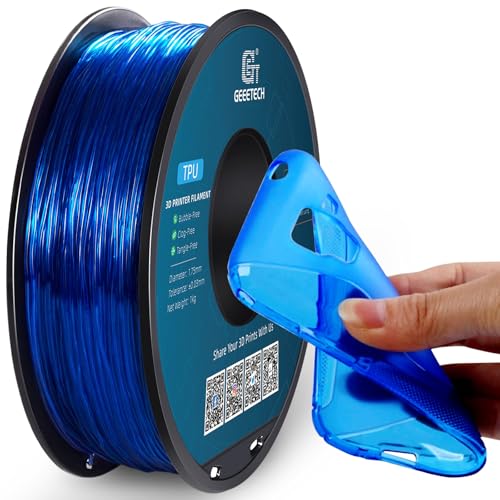
Geeetech TPU Filament is crafted with a 95A shore hardness, balancing elasticity and toughness for flexible prints. It’s designed to withstand daily wear, minor impacts, and deformation, making it suitable for phone cases, insoles, watch bands, and robotics parts. The filament employs a patented clog-free formula and a 24-hour pre-drying process to minimize jams, with vacuum-sealed packaging and desiccants to keep moisture out between uses.
OVERTURE TPU Filament 1.75mm

OVERTURE TPU Filament emphasizes high-quality material with a 95A Shore hardness for flexible yet strong prints. It highlights excellent layer adhesion for smooth surfaces and a clog-free design, with thorough 24-hour drying and vacuum-sealed storage. The result is consistent extrusion and reliable performance across a range of flexible projects, from wearable accessories to protective components.
Comgrow TPU Filament 1.75mm

Comgrow TPU Filament combines a 95A durometer with a 1.75mm diameter and a 1 kg spool. It provides soft yet durable prints with good bendability, maintaining structural integrity for flexible parts and objects. The filament is designed for compatibility with most FDM printers, enabling broad use in practical and decorative applications alike.
JAYO TPU 3D Printer Filament Bundle

The JAYO TPU bundle offers a four-spool package totaling 1 kg, with 250 g each in Black, Clear, Blue, and Red. The 95A Shore hardness provides dependable flexibility and strength for everyday objects that require give without sacrificing durability. The bundle format is ideal for users exploring multiple color and finish options in a single purchase.
AMOLEN 95A TPU 3D Printer Filament Glow in The Dark Green
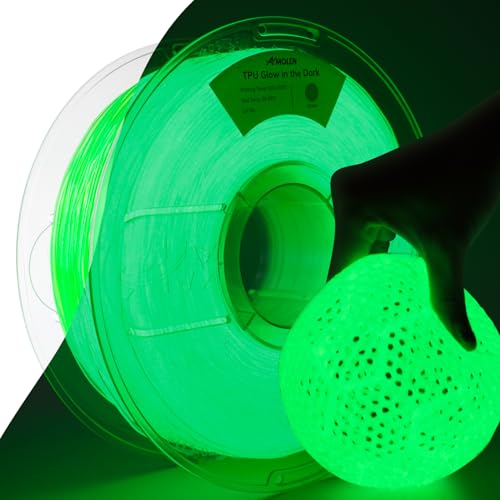
AMOLEN’s Glow in the Dark TPU uses 95A hardness for a strong yet flexible filament. The glow feature adds visibility in low light, making it suitable for creative displays and night-time projects. It maintains excellent elasticity while offering a durable finish, with a 1 kg spool and dimensional accuracy around 1.75 ± 0.02 mm to support reliable extrusion on most 3D printers.
AMOLEN TPU 3D Printer Filament 1.75mm White

AMOLEN’s standard TPU filament delivers a balanced mix of softness and resilience, designed for smooth high-speed printing. The 1.75mm filament supports a wide range of FDM printers, emphasizing good shaping, minimal bubbles, and stable extrusion. It’s a versatile choice for arts, crafts, and practical flexible components, with a focus on preventing jams and warping during longer print runs.
Buying Guide
- Filament hardness: Most TPU filaments hover around 95A. Softer options (lower Shore) bend more easily but can be harder to control; stiffer options (higher Shore) maintain shape under load but may feel less flexible.
- Printer compatibility: Check your extruder temperature range and bed adhesion capabilities. TPU typically prints best at moderate temperatures with good cooling and a flexible extruder path to resist jams.
- Drying and storage: TPU absorbs moisture. Many brands recommend drying before printing or storing in desiccant-equipped packaging. Re-drying helps prevent bubbling and poor adhesion.
- Dimensional accuracy: Look for tolerances around ±0.02 to ±0.03 mm. Tighter tolerances reduce calibration challenges and improve fit-for-purpose parts.
- Printing speed vs. reliability: Some TPU materials advertise fast-print capabilities. Balance speed with layer adhesion and nozzle cleanliness to avoid skipping layers or clogging.
- Color and finishes: Filaments come in various colors and some with glow-in-the-dark properties. Consider usage: aesthetics, visibility, or functional labeling may guide color choice.
- Storage and shelf life: Vacuum-sealed packaging with desiccants helps maintain performance. After opening, reseal and store in a dry environment to preserve elasticity.
- Bundle options: Multi-spool bundles offer color variety and cost efficiency, useful for projects requiring several hues or test prints before final builds.
When selecting a TPU filament, evaluate your printer’s extrusion stability, the filament’s drying protocol, and your target application—whether it’s flexible wearables, protective housings, or decorative parts. The products listed provide varied balances of elasticity, print speed, and ease of use for both beginners and experienced makers.