Best Underlayment for Ceramic Tile: Top Options for Durability and Crack Prevention
Choosing the right underlayment is essential for ceramic tile projects, especially in areas prone to movement, moisture, or temperature changes. The following picks are designed to minimize cracking, improve waterproofing, and extend tile life. Each product below highlights the core benefits, materials, and coverage to help you compare quickly.
| Product | Brand | Key Benefit | Approx. Coverage | Amazon Link |
|---|---|---|---|---|
| Vivlly 1/8″ Uncoupling Membrane (3.3ft x 32.8ft) | Vivlly | Anti-fracture, waterproof underlayment | 108 sq ft | View |
| Vivlly 1/8″ Uncoupling Membrane (3.3ft x 45.9ft) | Vivlly | Substrate movement absorption, waterproof | 150 sq ft | View |
| Schluter Ditra Uncoupling Membrane (54 sq ft) | Schluter | Crack isolation and moisture barrier | 54 sq ft | View |
| Houseables Uncoupling Membrane (3.3 ft x 98.5 ft) | Houseables | Crack prevention and vapor barrier | 323 sq ft | View |
| MAPEI Mapeguard UM (323 sq ft) | Mapei | Crack isolation and waterproofing | 323 sq ft | View |
Note: This table offers a snapshot of each underlayment’s core strengths. For detailed specifications, review each product’s features and installation guidance on the product page.
Vivlly 1/8” Uncoupling Membrane (3.3ft x 32.8ft)

Vivlly’s uncoupling membrane provides a thick, pressure-absorbing underlayment for ceramic tile, stone tile, and various flooring scenarios. It distributes substrate movement to protect tiles from fractures caused by shrinking or expansion. The material combines high-density polyethylene (HDPE) with premium textile components to deliver a durable moisture barrier suitable for kitchens, baths, saunas, and more. The 108-square-foot layout suits medium projects and installations where movement is a concern.
Key features include multipurpose use across bathroom floors, shower walls, and other areas, a robust barrier against moisture, and a design that balances cushion with structural support. Installation should follow thin-set bonding procedures, ensuring even contact with the substrate and proper cure time for strong tile adhesion.
Vivlly 1/8” Uncoupling Membrane (3.3ft x 45.9ft)

This longer Vivlly option shares the same core benefits as the shorter roll, including crack prevention, movement absorption, and a waterproof moisture barrier. It expands coverage to about 150 square feet per roll, making it well-suited for larger bathrooms, basements, or open-plan installations where consistent uncoupling and moisture protection are critical. The membrane’s HDPE construction helps guard against substrate movement transferring to tile.
Consider this roll when projects require extended runs without seams that could compromise crack isolation. As with any underlayment, ensure proper alignment, full contact with the substrate, and careful trimming around irregular areas to maintain performance.
Schluter Ditra Uncoupling Membrane (54 Sq Ft)

Schluter Ditra is a renowned uncoupling and waterproofing membrane designed to prevent cracking and delamination in ceramic and stone tile installations. It provides a reliable barrier against moisture while freeing tiles from substrate stresses. Compatible with many substrates, including concrete, plywood, OSB, and gypsum, Ditra is known for straightforward installation with thin-set mortar. Its polyethylene construction delivers an effective crack-isolation layer, especially in floors with potential movement.
For installations with heated floors or high-moisture zones, Ditra offers compatibility and peace of mind by separating substrate movement from tile while maintaining a durable surface. Proper substrate preparation and careful roll-out help maximize Ditra’s performance and longevity.
Houseables Uncoupling Membrane (3.3 ft x 98.5 ft)
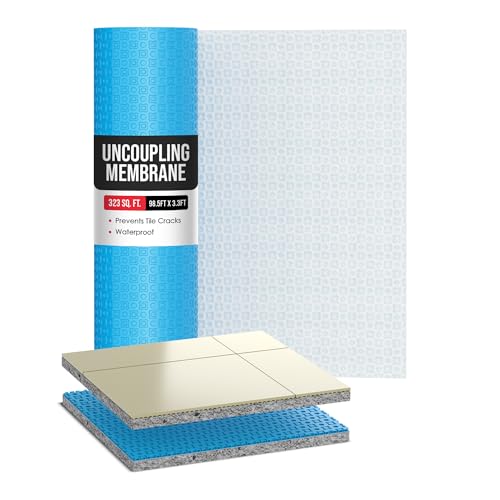
Houseables offers a wide, long roll designed to uncouple tile installations from substrate movement, reducing crack risk and preventing upward transmission of substrate changes. The membrane acts as a moisture and vapor barrier, contributing to a stable tile bed and long-lasting performance in floors and wet areas. A 3.3-foot width and 98.5-foot length translate into substantial coverage per install, with minimal added thickness to the overall floor profile.
Installation steps involve laying down thin-set on the substrate, applying the membrane, and continuing tile work. The membrane’s antifracture properties help to cushion tiles against expansion, contraction, and other substrate movements, supporting a durable ceramic tile finish.
MAPEI Mapeguard UM Underlayment Membrane (323 sq ft)

MAPEI Mapeguard UM combines crack isolation with waterproofing for ceramic tile, porcelain, and natural stone installations. This HDPE underlayment protects against substrate cracks while serving as a reliable moisture barrier, ideal for bathrooms, kitchens, and other moisture-prone areas. It is compatible with concrete, plywood, and existing tile, offering flexible installation across diverse substrates. Mapeguard UM’s uniform thickness supports consistent tile bedding and helps reduce maintenance concerns over time.
Key advantages include effective crack isolation, moisture protection, and broad substrate compatibility. For projects involving older or uneven subfloors, UM can help manage irregularities without compromising tile integrity, making it a versatile choice for renovations and new installations alike.
Mapeguard UM 35 Uncoupling Membrane (323 Sq Ft)

Mapeguard UM 35 is a high-performance crack isolation and waterproofing membrane designed for ceramic tile and stone installations. With a 1/8 inch (3 mm) thickness, it targets challenging substrates and elevations, providing vapor management and consistent performance. Its roll format helps cover large areas efficiently, making it suitable for projects with extensive tiled floors or showers. The product emphasizes crack isolation while enabling reliable moisture protection across varied substrates.
Consider UM 35 for renovations involving older concrete or single-layer plywood subfloors, where movement reduction and moisture resistance are priorities. The uniform thickness helps ensure even tile bed and consistent grout lines across expansive areas.
MAXWAVE 17″ x 150′ Underlayment

MAXWAVE offers a wide, long membrane designed for flexible cutting to fit various shower walls, floors, and under-tile applications. The 20-mil (0.51 mm) thickness and HDPE-based construction provide moisture resistance, tear resistance, and compatibility with a range of substrates. Continuous filament fiber exterior and reinforced sides improve durability under load and movement. The membrane also acts as a vapor retarder, which is valuable in high-humidity environments like steam rooms and baths.
For large-format projects, this roll’s length and width help minimize seams, supporting consistent performance. When installing, measure the area carefully and trim with scissors or a knife to match curves and irregular spaces while ensuring full bond with the thin-set beneath.
Buying Guide: Key Purchase Considerations For Tile Underlayment
When selecting an underlayment for ceramic tile, several factors influence performance and long-term results. Consider the following perspectives to choose the right product for your project:
- Crack isolation vs. moisture protection: Some membranes prioritize crack isolation, while others emphasize moisture barriers. In wetter areas or with exceptionally movement-prone substrates, prioritize a membrane that delivers both.
- Substrate compatibility: Check whether the underlayment works well with concrete, plywood, OSB, existing tile, or a combination. Substrates influence installation method and long-term durability.
- Thickness and coverage: Thicker membranes often provide better cushioning but add more height. Assess total thickness relative to door thresholds, trim, and cabinet clearances. Coverage per roll affects project planning and waste.
- Heated floors compatibility: If you plan to install on radiant heating, verify compatibility with your chosen underlayment and tile adhesive system.
- Moisture management: In bathrooms and wet rooms, moisture vapor management helps prevent mold and substrate deterioration. Look for high-quality HDPE or similar barrier materials.
- Ease of installation: Rolls with uniform thickness and simple cutting patterns save time on large areas. Consider products with clear installation guidelines and compatibility with standard thin-set mortars.
- Long-term durability: For spaces with temperature fluctuations or daily use, durability under load and movement is essential to prevent future repairs and re-tiling.
In summary, the best underlayment depends on project specifics: location (wet vs dry), substrate type, extent of movement, and project size. The options above provide a range of crack isolation and waterproofing strengths, allowing you to balance budget with performance for reliable ceramic tile installations.