Best Volt Ohm Meter for Home and Workshop
Finding a reliable volt-ohm meter (VOM) is essential for safe and accurate electrical testing. This guide highlights five top-rated models that balance precision, safety features, and user-friendly design. Whether you’re a DIYer, student, or professional, these meters cover common tasks like voltage, current, resistance, continuity, and diode checks. Explore practical insights, compare key features, and use our buying guide to pick a meter that fits your projects and budget.
Product Quick Reference
| Product | Brand | Key Use | Voltage Range | Notes |
|---|---|---|---|---|
| Klein Tools MM325 Multimeter | KLEIN TOOLS | Voltage, current, resistance, continuity, diodes, battery | 600V AC/DC | Lead-alert protection, backlit display |
| AstroAI Digital Multimeter 2000 Counts | AstroAI | Voltage, current, resistance, continuity, diode | AC/DC voltage, 2000 counts | Backlit display; caution notes in manual |
| AstroAI TRMS 6000 Counts DMM | AstroAI | Voltage, current, resistance, capacitance, frequency, duty cycle, temperature | AC/DC up to 6000 counts | True RMS; auto-ranging; data hold |
| KAIWEETS HT118A Digital Multimeter | KAIWEETS | Voltage, current, resistance, diodes, continuity, NCV | 1000V DC / 750V AC | Non-contact voltage; large backlit display |
| Crenova MS8233D Multimeter | Crenova | Voltage, current, resistance, capacitance, frequency, NCV | 6000-count LCD | Protective casing; CAT III 600V rating |
Klein Tools MM325 Multimeter

The Klein Tools MM325 is a manual-ranging meter designed for professionals and serious hobbyists. It measures AC/DC voltage up to 600V, supports 10A DC current, and tests resistance up to 2 MΩ. Additional tests include continuity, diode test, and a dedicated battery test. A notable safety enhancement is Lead-Alert protection, with LEDs indicating proper test lead placement to improve accuracy and safety during measurements. The backlit LCD display helps readings in dim environments, making it a practical choice for fieldwork and shop use.
AstroAI Digital Multimeter 2000 Counts

The AstroAI 2000-count digital multimeter provides essential measuring capabilities for common electrical tasks. It accurately measures AC/DC voltage, DC current, resistance, continuity, and diode tests. The model includes practical notes about operation to avoid measurement errors, such as ensuring leads are properly inserted and the rotary switch is positioned correctly. While suitable for most household and light-industrial troubleshooting, users should consult the manual for certain limitations and ensure compatibility with higher-current or specialized circuits.
AstroAI TRMS 6000 Counts Digital Multimeter

This AstroAI TRMS meter targets more demanding testing tasks. It measures AC/DC current, AC/DC voltage, capacitance, frequency, duty cycle, resistance, diode, continuity, and temperature. Notable features include auto-ranging, a large backlit display, data hold, and a kickstand. It offers True RMS for more accurate readings on non-sinusoidal waveforms, making it suitable for automotive and industrial troubleshooting where waveform quality matters. The device is designed for easier operation with a clear indicator system and sturdy build.
KAIWEETS HT118A Digital Multimeter
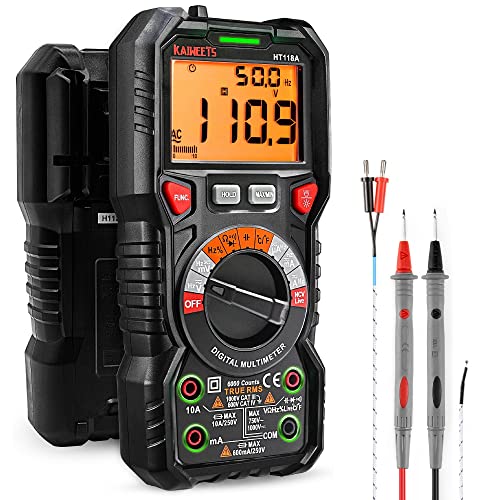
The KAIWEETS HT118A is a feature-rich meter with high-voltage capability (up to 1000V DC / 750V AC) and a 6000-count display for precise readings. It measures voltage, current, resistance, diodes, and continuity, and adds non-contact voltage testing with audible and visual alarms. A bright backlit screen, stable kickstand, and data functions such as Min/Max recording make it user-friendly for automotive, electrical, and DIY projects. The device also emphasizes convenience with a pen slot and auto-power-off features.
Crenova MS8233D Multimeter

The Crenova MS8233D Multimeter combines broad measurement capabilities with protective design. It measures DC/AC voltage, DC/AC current, resistance, capacitance, frequency, duty cycle, and continuity, and can test diodes and NCV. The device adheres to safety standards (CAT III 600V) and includes two built-in fuses for overload protection on all ranges. Its 6000-count LCD with a bright backlight supports easy reading in dim environments, while the robust housing enhances user safety during fieldwork and shop tasks.
Buying Guide: How To Choose The Right Volt Ohm Meter
- Measurement range and accuracy: Determine the voltage and current ranges you’ll encounter. True RMS (TRMS) meters provide more accurate readings for non-sinusoidal signals, such as motor loads and electronic devices.
- Safety and protection: Look for CAT ratings (e.g., CAT III 600V) and features like lead-alert or non-contact voltage (NCV) testing to reduce shock risk and prevent misreadings.
- Display and readability: A backlit LCD and a clear display improve usability in dim work environments. If you’ll test outside or in tight spaces, a larger display helps.
- Auto-ranging vs. manual-ranging: Auto-ranging meters are easier for beginners, while manual-ranging meters offer control for experienced users dealing with known ranges.
- Additional functionalities: Consider whether you need capacitance, frequency, duty cycle, temperature, or NCV testing. Some models include data hold, Min/Max, and a kickstand for convenient bench use.
- Durability and form factor: Choose a meter with a sturdy housing and comfortable grip if you’ll use it in the field. A built-in stand and protective holster add practical value.
- Battery and power: Check the type and availability of replacement batteries. Some models include batteries in the package, which reduces initial setup steps.
- Included accessories: Probes, test leads, and a case impact overall usability. Verify that leads are rated for the voltage level and that insulation is durable for repeated use.
- Intended use: For automotive tasks, ensure the meter handles automotive loads and can test live wires safely. For electronics and home wiring, confirm compatibility with lower-current measurements and diode checks.
Overall, the five meters featured here offer a balance of safety, versatility, and ease of use. Depending on your projects—household wiring, automotive diagnostics, or electronics troubleshooting—match the meter’s capabilities to your typical measurement tasks and environment. Always follow manufacturer safety guidelines and start with lower voltage levels when testing unknown circuits.