Best Infrared Thermometers for HVAC: Non-Contact Temperature Tools for Pro Helpers
Choosing the right infrared thermometer for HVAC work means balancing speed, accuracy, and safety. The devices below cover common HVAC tasks—from checking duct temps and evaporator coils to verifying system performance without contact. Each model offers a mix of emissivity control, fast response, and a clear readout to streamline field diagnostics. Below you’ll find five well-suited options, with key strengths for technicians, homeowners performing repairs, and contractors managing multiple systems. Use the Buying Guide at the end to compare features and pick the best fit for your projects.
| Product | Brand | Best For |
|---|---|---|
| ThermoPro TP30 Infrared Thermometer Gun | ThermoPro | General HVAC checks, quick surface temps |
| Klein Tools IR1 Infrared Thermometer | KLEIN TOOLS | Distance readings with 10:1 ratio |
| Etekcity Infrared Thermometer Upgrade 774 | Etekcity | Multi-purpose cooking and HVAC surface temps |
| ThermoPro TP420 2-in-1 Instant Read Thermometer | ThermoPro | Surface + internal temps with probe |
| Upgrade 2023 Laser Infrared Thermometer Non-Contact | DEASOMIYE | Industrial/high-temp surface measurements |
Note: Each product listed offers non-contact measurements and broad temperature ranges suitable for HVAC environments. Do not use these devices to measure human body temperature. Emissivity controls, distance-to-spot ratios, and response times vary by model, affecting accuracy and usability in different HVAC tasks.
ThermoPro TP30 Infrared Thermometer Gun
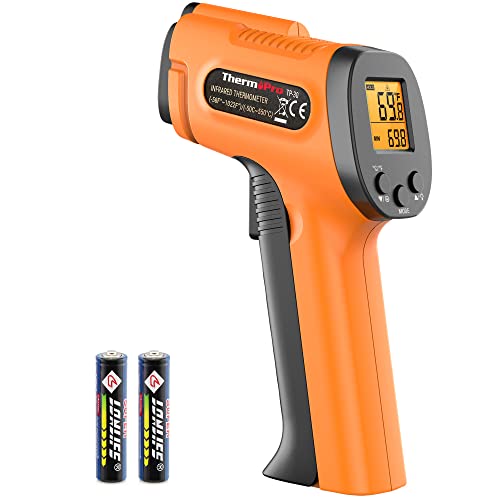
The TP30 uses a thermopile sensor with ±1.5% accuracy, suitable for HVAC surface readings. Adjust emissivity from 0.1 to 1.0 to align with different surface materials, improving measurement relevance on metallic ducts or painted surfaces. It offers a 12:1 distance-to-spot ratio and a response time under 500 milliseconds, delivering rapid results from a safe distance. Temperature range spans -58°F to 1022°F (-50°C to 550°C), enabling quick checks from evaporator coils to hot coils in furnaces and engines. This model is appropriate for HVAC, auto work, and home repairs where non-contact surface temperature matters.
Key features include adjustable emissivity, fast readings, and a broad range. For technicians, the TP30 provides dependable performance when inspecting heat transfer across surfaces and components, though it lacks a built-in probe for internal readings.
Klein Tools IR1 Infrared Thermometer
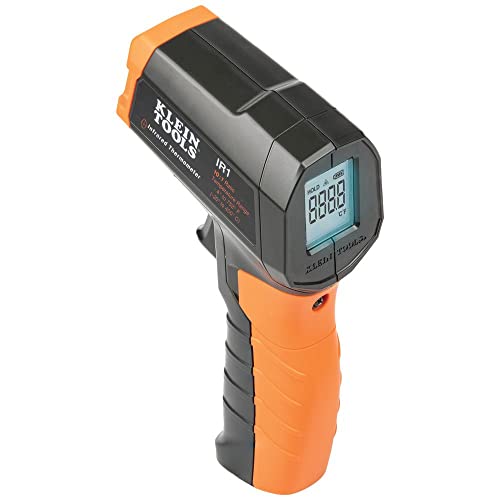
The IR1 offers a durable non-contact option with a 10:1 distance-to-spot ratio and a measurement range of -4°F to 752°F (-20°C to 400°C). Laser targeting supports precise aiming, while a backlit display helps readings in dim mechanical rooms. The unit includes fixed emissivity for convenient use on typical HVAC surfaces, and basic auto power-off helps conserve battery life. This model is well-suited for quick HVAC surface checks on ducts, vents, and coils, with dependable accuracy at a reasonable price point.
Pros include straightforward operation and strong targeting; cons include fixed emissivity, which may limit accuracy on highly reflective or unusual materials without calibration.
Etekcity Infrared Thermometer Upgrade 774

The 774 model positions itself as a versatile tool for both kitchen and HVAC use. It features an uncomplicated interface with a substantial measurement range that supports -58°F to 842°F (-50°C to 450°C). It emphasizes versatility, lending itself to checking oven surfaces, grills, HVAC components, and other surfaces. The device’s accuracy, rapid response, and 12:1 distance-to-spot ratio make it a practical part of a technician’s toolkit for surface temperature checks, spot readings on ducts, and early problem detection in HVAC systems.
Strengths include broad applicability and user-friendly operation. Limitations may include generic emissivity controls that do not provide deep customization for all materials encountered in HVAC inspections.
ThermoPro TP420 2-in-1 Infrared and Probe Thermometer

The TP420 combines a surface infrared thermometer with a meat-style probe for internal temperatures, enabling a broader range of HVAC and kitchen tasks. It offers a ±1.8°F accuracy for internal readings within a short 2–3 seconds and a wide surface range from -58°F to 572°F. Its 12:1 distance-to-spot ratio and sub-500 ms response time support rapid, non-contact measurements from a safe distance. This dual-function tool helps verify surface temperature on equipment like coils or griddles and cross-checks internal temps in cooking scenarios, which can be useful for certain HVAC installations that involve heat exchangers or packaged units with integrated sensors.
Choosing the TP420 provides flexibility. The trade-off is slightly more complexity due to the probe, which adds measurement versatility but requires additional handling when switching between modes.
Upgrade 2023 Laser Infrared Thermometer Non-Contact

This DEASOMIYE model emphasizes industrial-grade capability with a wide range of -58°F to 1112°F (-50°C to 600°C) and a 0.5-second response time. It notes a 14-inch target distance for best accuracy, making it suitable for high-heat HVAC components such as furnaces and industrial equipment. A notable caution is that it is not for human temperature measurement, aligning with professional, non-clinical use cases. The device supports multiple surfaces common in HVAC tasks and offers a robust 50:1 distance-to-spot ratio for safe operation in hot environments.
Pros include very high max temperature, fast response, and strong distance-to-spot performance. Users should be mindful of the industrial focus and required distance, which may be less convenient for tight spaces.
Buying Guide: Key Purchase Considerations for HVAC Infrared Thermometers
Choosing the right infrared thermometer for HVAC involves assessing several factors that impact accuracy, safety, and ease of use. Consider emissivity control, distance-to-spot ratio, temperature range, response time, and display features. Here are multiple perspectives to help you decide:
- Emissivity control: If you frequently measure metals, plastics, or painted surfaces, opt for models with adjustable emissivity (usually 0.1 to 1.0). This improves accuracy across various HVAC surfaces such as ducts, heat exchangers, and metal coils.
- Distance-to-spot ratio (D:S): A higher D:S (for example, 12:1 or 50:1) allows you to measure small areas from a greater distance. This is valuable when working near hot components or in tight mechanical rooms.
- Temperature range and accuracy: Ensure the device covers the expected HVAC temperature spectrum, from cold ducts to hot coils. Look for claims of ±1.5°F to ±2°F accuracy for reliable diagnostics.
- Response time: Fast readings (under 500 milliseconds) help you quickly assess multiple targets, especially on moving components or during system checks.
- Probe capability: Some models add a detachable or integrated probe for internal temperature checks. This is useful when verifying internal temperatures in conduits or air-handler components where non-contact readings aren’t sufficient.
- Durability and ergonomics: HVAC work often occurs in industrial environments. A sturdy build, comfortable grip, and backlit displays are advantageous for long job days and dim service spaces.
- Safety and use-case alignment: Always use non-contact thermometers for surface temperatures and avoid using any device on humans unless specifically designed for medical use. Follow manufacturer guidelines for distance and handling to avoid burns or inaccuracies.
- Price-to-performance balance: For frequent HVAC use, prioritize models with durable construction, reliable sensors, and features that directly improve work efficiency, such as emissivity controls and fast response times.
In summary, the five selected models cover a spectrum from cost-effective, straightforward surface thermometers to more versatile tools with internal temperature capabilities. Your choice should align with the typical HVAC tasks you perform, the surfaces you measure, and how often you need quick, accurate readings in challenging environments.