Best R Value Insulation for Garage Walls
Choosing the right insulation for garage walls matters for year-round comfort and energy savings. The products below are designed to boost thermal resistance (R-value) and reduce heat transfer, noise, and drafts. This guide highlights five top options, including spray foams, reflective foils, and multi-layer panels, to help homeowners compare installation ease, coverage, and overall performance for garage spaces.
| Product | Brand | R-Value Indication | Type |
|---|---|---|---|
| BEEST FullStop Spray Foam Insulation Kit | BEEST | R-Value 8.14 (with 2″ application) | One-component spray foam for walls and attic |
| Reach Barrier 3009 Garage Door Insulation Kit | Reach Barrier | Reflective insulation with radiant heat control | Pre-cut reflective panels |
| NASA TECH White Reflective Foam Core Kit (18 x 8 ft) | US Energy Products | R-Value 8.0 (kit) | Foam-core reflective insulation |
| SmartSHIELD -5mm Reflective Foam Core Insulation Roll | INSULATION MARKETPLACE | R-Value up to 15.67 (one layer); 21.10 (two layers) | Foil-faced foam core radiant barrier |
| 16P Garage Door Insulation Panels Kit | MYFAMIREA | 6mm foam/bubble panels with reflective foil | Pre-cut reflective insulation panels |
Note: Each product affects garage walls differently—spray foams seal gaps and add substantial cavity insulation, while reflective foils and foam-core rolls primarily limit radiant heat and improve overall assembly performance. Consider climate, existing walls, and installation preferences when selecting a solution.
BEEST FullStop Spray Foam Insulation Kit
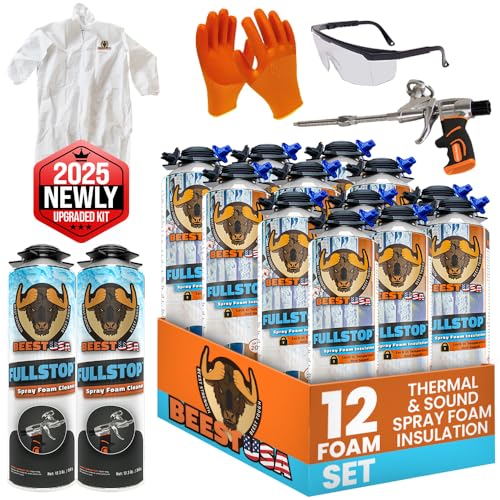
BEEST FullStop is a DIY spray foam kit marketed for walls and ceilings, delivering an R-Value of about 8.14 when applied at the recommended 2-inch thickness. The kit includes 12 cans, a heavy-duty gun, and cleaners, enabling quick sealing of gaps and irregular surfaces. This product is designed for broader coverage (up to 240 sq ft) in typical garage spaces and is suitable for hard-to-reach areas where traditional insulation struggles. Proper application temperature (68–77°F) supports consistent expansion and adhesion, helping to reduce drafts and improve energy efficiency.
Key features include a bundled set for safe, efficient application and an emphasis on reducing energy usage by creating a continuous air seal. Potential considerations are the need for ventilation during application, curing time, and working with a spray foam system that requires careful handling and protective equipment.
Reach Barrier 3009 Garage Door Insulation Kit

Reach Barrier 3009 uses reflective insulation and a bubble barrier approach to minimize radiant heat transfer. The kit features layered panels with two layers of barrier bubble sandwiched between reflective polyethylene, designed to deliver more consistent R values and resilience against radiant heat. It’s presented as easy to install, with pre-cut panels and no required special tools or protective clothing. This option is well-suited for quick upgrades on garage walls adjacent to exterior exposures and for homeowners seeking a non-mpray alternative to spray foams.
Considerations include the performance impact of radiant heat reduction in hot climates and how well the panels fit interior wall dimensions. Fire codes and maintenance requirements are stated as met by the product design, yet always verify local code requirements and ensure proper sealing at edges for best insulation performance.
NASA TECH White Reflective Foam Core Kit

NASA TECH White Reflective Foam Core is designed for 18×8 foot garage spaces (wide x high) and advertises an R-value of 8.0. The kit includes four rolls of 2 ft x 18 ft foam-core insulation, heavy-duty double-sided tape, a razor, squeegee, and easy-to-follow instructions. Made in the USA and aligned with fire code standards, these kits aim to simplify installation for garage door areas and adjacent walls, offering a high-reflectivity surface to reduce radiant heat exchange.
The kit emphasizes a straightforward installation process and a strong emphasis on complete surface coverage. Pros include clear instructions and included mounting accessories; potential drawbacks involve the need to trim and fit rolls to fit irregular wall geometries and ensuring a proper seal at seams for optimal R-value performance.
SmartSHIELD -5mm Reflective Foam Core Insulation Roll

SmartSHIELD rolls offer a high R-value potential, showing up to 15.67 with a single layer and up to 21.10 with two layers. The product combines insulation, a radiant barrier, and a vapor barrier in one, with a clean white appearance that requires no painting. It’s described as highly effective for reflecting radiant energy and preventing condensation, meeting or exceeding ASTM C1313 standards for Class A fire ratings. This roll is suitable for continuous wall or ceiling applications where space allows a layered installation approach.
Key trade-offs include achieving the maximum R-value by layering correctly and ensuring adequate ventilation during installation. As with all radiant barriers, performance improves when installed with tight seams and minimal gaps, and it may be most advantageous in sunny climates or heat-prone garages.
16P Garage Door Insulation Panels Kit

16P offers 6mm-thick aluminum foil panels with bubble insulation in a pre-cut format designed for garage door applications, but many homeowners adapt these panels for adjacent walls as well. The kit emphasizes energy savings by reflecting heat and sealing gaps. The panels are described as lightweight, durable, and easy to handle, with reflective foil and bubble layers aimed at reducing heat transfer in both hot and cold seasons. As a wall-insulation option, it may pair well with other solutions to increase overall R-value and reduce drafts.
Installation considerations include panel fitment, compatibility with wall framing, and ensuring clean, tight corners to maintain energy efficiency gains. Temperature and humidity conditions during installation can influence adhesive performance and seam sealing.
Buying Guide: Key Considerations For Garage Wall Insulation
- R-value goals: Identify the target R-value for your climate and garage use. Spray foams typically deliver higher R-values per inch, while reflective foils primarily reduce radiant heat and work best in sunny or hot environments.
- Application method: Consider ease of installation, required tools, and space for curing or drying. DIY spray foams require ventilation and protective gear, while panels and rolls often need precise cutting and edge sealing.
- Moisture control: Vapor barriers help manage condensation. In attached garages, consider moisture and humidity levels to prevent mold or peeling.
- Air sealing: Gaps around edges and corners undermine insulation value. Look for products that offer seamless or tight-fitting installation and minimal air leakage.
- Fire safety: Verify compliance with local codes and fire safety standards (Class A rating where applicable). Proper handling and ventilation are essential for spray foams.
- Durability and maintenance: Some materials are more resistant to wear, pests, or physical impact. Panels and reflective foils may be easier to maintain over time.
- Climate suitability: Reflective barriers perform differently by climate. In hot climates, radiant heat reduction is often a high priority; in colder areas, cavity insulation may take precedence.
- Cost and coverage: Compare coverage area per kit and cost per square foot. Higher upfront cost may be offset by long-term energy savings.
- Compatibility with existing walls: Some products are designed for uninsulated walls, while others are best used in retrofit scenarios. Ensure compatibility with studs, sheathing, and existing finishes.
- Maintenance and removal: If you anticipate future remodeling, consider how easy it is to remove or re-install the insulation without damaging walls.